Settings

Settings other than “Default” will be saved in local storage to persist across pages, reloads, and sessions.

Breaking Provably Secure Schemes: OCB2

Applied Cryptography

These slides are from a lecture I designed and repeatedly gave in the course on Applied Cryptography at TU Eindhoven.

It was placed as the second lecture in the course, to be given in the same weak as the first one, that was meant to introduce provable security and the random oracle model. The idea here was to first introduce the students to security proofs and show them how they are important, only to then demonstrate on a high-profile example, that proofs can very much still be wrong.

Also note that I gave the lecture in a classroom with a blackboard, where it was far easier to explain some of the more technical things; the recording I provide here did not have that benefit and also lacks tracking of any pointers, making especially the explanation of some of the more technical mathematical aspects less ideal. Still though: This is primarily a slide-show and a lot of information was meant to be passed via the spoken word, so I would generally still reocmmend to view it in slide-show mode with the recording. (I don’t have captions as of now, and given that this is a full hour recording, I won’t make any promises for how soon (if ever) they’ll be available. Sorry.)

Overview

I am only providing the slides for the second lecture here, since the slides for the first lecture are not mine, but Andreas Hülsing’s who was (and is) the responsible professor for the overal course; that said, I understand that this creates the somewhat unfortunate situation that the following slides might assume more previous knowledge than would be ideal, but it is what it is…

Last Time: Proofs are important

  • Allow quick development of protocols
  • Focuses cryptanalytic research on fewer targets.
  • Enforces the use of formal security statements

Today: Proofs are not a silver Bullet

  • Are the assumptions true?
  • Are the assumptions used correctly?
  • Does the proof really say what you think it does?
  • Is the proof itself correct?

Blockciphers and Modes

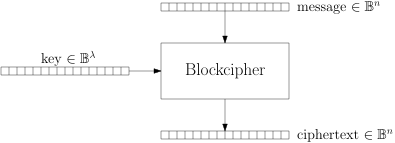
  • Take a key k𝔹λk \in \mathbb{B}^\lambda and a message-block m𝔹nm \in \mathbb{B}^n and return a ciphertext-block c𝔹nc \in \mathbb{B}^n. (𝔹:={0,1}\mathbb{B} := \{0,1\})
A message is fed into a blockcipher and transformed into a ciphertext; the blockcipher also receives a key that may, but does not have to be of the same length.
  • “Keyed Permutation” or “PseudoRandom Permutation” (PRP)
  • If kk is unknown, its associated permutation should be indistinguishable from a truly random permutation.

Formal Definition (for Completeness)

PRP-security in the CPA setting:

𝒜PPT:|Pr[𝒜Ek()(1λ)1|k𝔹λ]Pr[𝒜π()(1λ)1|πΠ]|<negl(λ)\forall \mathcal{A} \in \mathrm{PPT}: \left| \begin{array}{l} \Pr\left[\mathcal{A}^{E_k(\cdot)}(1^\lambda) \Rightarrow 1 \middle|k \leftarrow \mathbb{B}^\lambda\right]\\ -\Pr\left[\mathcal{A}^{\pi(\cdot)}(1^\lambda)\Rightarrow 1\middle|\pi \leftarrow \Pi\right] \end{array} \right| < \mathrm{negl}(\lambda)

PRP-security in the CCA setting:

𝒜PPT:|Pr[𝒜Ek(),Dk()(1λ)1|k𝔹λ]Pr[𝒜π(),π1()(1λ)1|πΠ]|<negl(λ)\forall \mathcal{A} \in \mathrm{PPT}: \left| \begin{array}{l} \Pr\left[\mathcal{A}^{E_k(\cdot), D_k(\cdot)}(1^\lambda) \Rightarrow 1 \middle|k \leftarrow \mathbb{B}^\lambda\right]\\ -\Pr\left[\mathcal{A}^{\pi(\cdot), \pi^{-1}(\cdot)}(1^\lambda)\Rightarrow 1\middle|\pi \leftarrow \Pi\right] \end{array} \right| < \mathrm{negl}(\lambda)

  • Not an Encryption Scheme! Merely a building-block.

Modes: ECB

Tux
Our Plaintext.
Also Tux, but every equal run of four pixels is replaced with a pseudorandom sequence; the image is still highly recognizable however, because large areas that have the same color in the plaintext still look quite flat in the ciphertext.
After Encryption with AES in ECB-mode.

Modes: CTR

Tux again
Same Plaintext.
An image that seems to purely consist of random noise
But this time encrypted with Counter-Mode

Modes: CTR

a mostly black image with a white gnu in the bottom center
Let’s XOR a gnu on top of the ciphertext
A ciphertext that looks like before
The result still looks random.

Modes: CTR

The same image of Tux as before, but with a clearly recognizable black gnu on his belly.
But once we decrypt…

Modes

  • Blockciphers are not encryption-schemes!

    • If someone tells you “We encrypt everything with AES”, look for penguins.
  • Secure modes are important and non-trivial!

  • Confidentiality alone is usually not enough!

    • IND-CPA + MAC sometimes works, but we can do much better…

AE(AD)

  • Authenticated Encryption (with Associated Data)
  • Ciphertext does not reveal information about the plaintext
    • except for its length
    • even with an encryption (and a decryption) oracle
    • even if the adversary chooses the nonces
  • It is impossible to create a valid ciphertext without knowledge of the key
    • even with an encryption and a decryption oracle
  • Essentially IND$-CPA + EU-CMA
    • IND$-CPA \approx IND-CPA with adversarially chosen nonces.
    • Combined these also imply CCA-security

Formal Definition of Confidentiality

𝒜PPT:|Pr[𝒜𝖤𝗇𝖼K(,,)(1λ)1|K𝔹λ]Pr[𝒜$(,,)(1λ)1]|<negl(λ)\begin{align*} &\forall \mathcal{A} \in \mathrm{PPT}:\\ &\left|\begin{array}{l} \Pr\left[\mathcal{A}^{\mathsf{Enc}_K(\cdot,\cdot,\cdot)}(1^\lambda) \Rightarrow 1\middle|K \leftarrow \mathbb{B}^\lambda\right]\\ -\Pr\left[\mathcal{A}^{\$(\cdot,\cdot,\cdot)}(1^\lambda) \Rightarrow 1\right]\\ \end{array}\right|< \mathrm{negl}(\lambda) \end{align*}

(Every oracle query must use a fresh nonce!)

For CCA-Security add a decryption-oracle. (Thanks to the authenticity it will however answer all fresh queries with ⊥)

Formal Definition of Authenticity

𝒜PPT:Pr[𝖣𝖾𝖼K(c*)|K𝔹λc*:=𝒜𝖤𝗇𝖼K(,,)(1λ)c*{oracle-responses}]<negl(λ)\begin{align*} &\forall \mathcal{A} \in \mathrm{PPT}:\\ &\Pr\left[\mathsf{Dec}_K(c^*) \neq \bot \middle|\begin{array}{l} K \leftarrow \mathbb{B}^\lambda\\ c^* := \mathcal{A}^{\mathsf{Enc}_K(\cdot,\cdot,\cdot)}(1^\lambda)\\ c^* \notin \{\text{oracle-responses}\} \end{array}\right]< \mathrm{negl}(\lambda) \end{align*}

(Every oracle query must use a fresh nonce!)

Offset Codebook Mode 2 (OCB2)

  • Invented by Phil Rogaway

  • ISO-standard

  • Little use in standardized internet-protocols due to patents

  • Nonce instead of random IV

  • \approx 1 blockcipher application per nn bits of message.

  • Almost no overhead beyond that.

Tweakable Blockcipher

  • Similar to regular blockciphers, but take an additional tweak.
  • Indistinguishable from a random permutation per tweak and per key.

Indistinguishability in the CCA setting: 𝒜PPT:|Pr[𝒜Ek(,),Dk(,)(1λ)1|k𝔹λ]Pr[𝒜f(,),f1(,)(1λ)1|f𝖯𝖾𝗋𝗆𝖥𝖺𝗆(𝒯,n)]|<negl(λ)\begin{align*} &\forall \mathcal{A} \in \mathrm{PPT}:\\ &\left| \begin{array}{l} \Pr\left[\mathcal{A}^{E_k(\cdot,\cdot), D_k(\cdot,\cdot)}(1^\lambda) \Rightarrow 1 \middle|k \leftarrow \mathbb{B}^\lambda\right]\\ -\Pr\left[\mathcal{A}^{f(\cdot,\cdot), f^{-1}(\cdot,\cdot)}(1^\lambda)\Rightarrow 1\middle|f \leftarrow \mathsf{PermFam}(\mathcal{T}, n)\right] \end{array} \right| < \mathrm{negl}(\lambda) \end{align*}

𝖯𝖾𝗋𝗆𝖥𝖺𝗆(𝒯,n)\mathsf{PermFam}(\mathcal{T}, n) samples a random permutation f(t,)f(t, \cdot) for each t𝒯t \in \mathcal{T}.

(For just CPA simply remove the decryption-oracles.)

XEX and XE

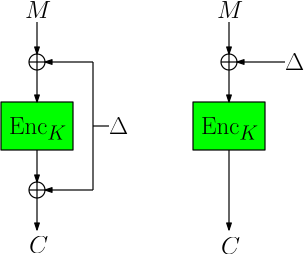
Flow diagram of XEX and XE: In both cases a message 𝑀 is XORed with a value Δ, before being fed into a blockcipher; in case of XE the output is used as ciphertext 𝐶, in case of XEX, it is first XORed with Δ again.

XEX and XE

  • Let α1,,αk𝔽2n×\alpha_1,\dots,\alpha_k \in \mathbb{F}_{2^n}^{\times} be primitive elements.
  • Let 𝕀:=𝕀1××𝕀k\mathbb{I} := \mathbb{I}_1 \times\dots\times\mathbb{I}_k with 𝕀i\mathbb{I}_i \subset \mathbb{Z} so that:
    • (i1,,ik),(i1,,ik)𝕀\nexists (i_1,\dots,i_k) ,(i'_1,\dots,i'_k) \in \mathbb{I} so that:
      • (i1,,ik)(i1,,ik)(i_1,\dots,i_k) \neq (i'_1,\dots,i'_k) and j=1kαjij=j=1kαjij\prod_{j=1}^{k} \alpha_j^{i_j} = \prod_{j=1}^{k} \alpha_j^{i'_j}
  • let N𝔹nN \in \mathbb{B}^n be a Nonce.
  • Compute L:=𝖤𝗇𝖼k(N)L := \mathsf{Enc}_k(N)
  • Compute Δ:=Lα1i1αkik\Delta := L \cdot \alpha_1^{i_1} \cdot \dots \cdot \alpha_k^{i_k}
  • Define 𝖷𝖤.𝖤𝗇𝖼k(m,N,i):=𝖤𝗇𝖼k(Δm)\mathsf{XE.Enc}_k(m, N, i) := \mathsf{Enc}_k(\Delta \oplus m)
  • Define 𝖷𝖤.𝖣𝖾𝖼k(c,N,i):=Δ𝖣𝖾𝖼k(c)\mathsf{XE.Dec}_k(c, N, i) := \Delta \oplus \mathsf{Dec}_k(c)
  • Define 𝖷𝖤𝖷.𝖤𝗇𝖼k(m,N,i):=Δ𝖤𝗇𝖼k(Δm)\mathsf{XEX.Enc}_k(m, N, i) := \Delta \oplus \mathsf{Enc}_k(\Delta \oplus m)
  • Define 𝖷𝖤𝖷.𝖣𝖾𝖼k(c,N,i):=Δ𝖣𝖾𝖼k(Δc)\mathsf{XEX.Dec}_k(c, N, i) := \Delta \oplus \mathsf{Dec}_k(\Delta \oplus c)

OCB2

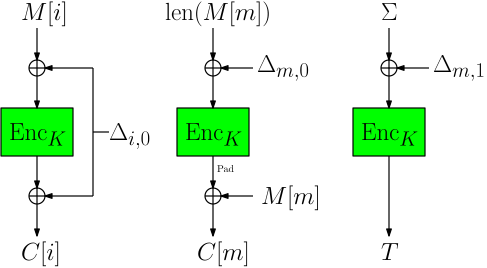
Three diagrams next to each other. The first one depicts the encryption of most blocks in OCB2, using XEX with Δᵢ₀ to encrypt the 𝑖-th block. The second uses Δₘ₀ and XE, to encrypt a length encoding for the length of the last, 𝑚’th, block, producing “Pad” which is then XORed with the last message-block to produce the last ciphertext-block. The third shows the computation of the authentication-tag as using XE on the checksum Σ with Δₘ₁ to produce the authentication-tag 𝑇; Σ is simply the XOR of all message-blocks.

Proof

Large difference between protocol and security game

→ “Game Hopping

XE is a CPA-secure tweakable blockcipher

𝒜\mathcal{A} always gets access to an (encryption-) oracle. The specific oracle is replaced multiple times:

  • Game 1: XE with actual blockcipher
  • Game 2: XE with a truly random permutation
  • Game 3: XE with a truly random function
  • Game 4: Truly random function
  • Game 5: Truly random permutation per tweak

Let pip_i be the probability that 𝒜\mathcal{A} outputs 1 in game ii.

Goal: |p5p1|<negl(λ)|p_5 - p_1| < \mathrm{negl}(\lambda)

From XE[Blockcipher] to XE[Random Permutation]

Claim: |p2p1|𝖠𝖽𝗏EPRP(t,2q)|p_2 - p_1| \leq \mathsf{Adv}_E^{\mathrm{PRP}}(t', 2q)

  • Replace all computations of the blockcipher with calls to the PRP-oracle.
  • If the PRP-challenger presents us the real blockcipher, this is identical to game 1.
  • If it presents the truly random permutation, this is identical to game 2.
  • If the CPA-attacker changes its behaviour between these to game, we can use that to distinguish between them.

|p2p1||p_2 - p_1| is bounded by the achievable advantage over the security of EE in the PRP-game!

From XE[Random Permutation] to XE[Random Function]

Claim: |p3p2|2q22n|p_3-p_2| \leq \frac{2q^2}{2^n}

  • Only different if a collision occurs
  • Outputs are truly random.
  • With 2q2q calls and blocksize of nn bits the probability for a collision is at most 122q(2q1)2n2q22n\frac{1}{2} \cdot \frac{2q(2q-1)}{2^n} \leq \frac{2q^2}{2^n}

⇒ Since the number of oracle queries (2q2q) is at most polynomial whereas 2n2^n is exponential in the security parameter, this is negligible.

From XE[Random Function] to Random Function

Then a miracle occurs…

It provides us with |p4p3|2q22n|p_4-p_3| \leq \frac{2q^2}{2^n}

From Random Function to Random Permutation

Claim: |p5p4|0.5q22n|p_5-p_4| \leq \frac{0.5q^2}{2^n}

  • Like second hop, just the other way around.

Putting it all together.

|p5p1||p5p4|+|p4p3|+|p3p2|+|p2p1|2q22n+2q22n+0.5q22n+𝖠𝖽𝗏EPRP(t,2q)=4.5q22n+𝖠𝖽𝗏EPRP(t,2q)\begin{align*} |p_5-p_1| &\leq |p_5-p_4| + |p_4-p_3| + |p_3-p_2| + |p_2-p_1|\\ &\leq \frac{2q^2}{2^n} + \frac{2q^2}{2^n} + \frac{0.5q^2}{2^n} + \mathsf{Adv}_E^{\mathrm{PRP}}(t', 2q)\\ &= \frac{4.5q^2}{2^n} + \mathsf{Adv}_E^{\mathrm{PRP}}(t', 2q) \end{align*}

⇒ Since both of these are by assumption negligible, XE with a secure blockcipher provides a secure tweakable blockcipher in CPA settings.

XEX and XEX*

  • The proof for XEX is similar
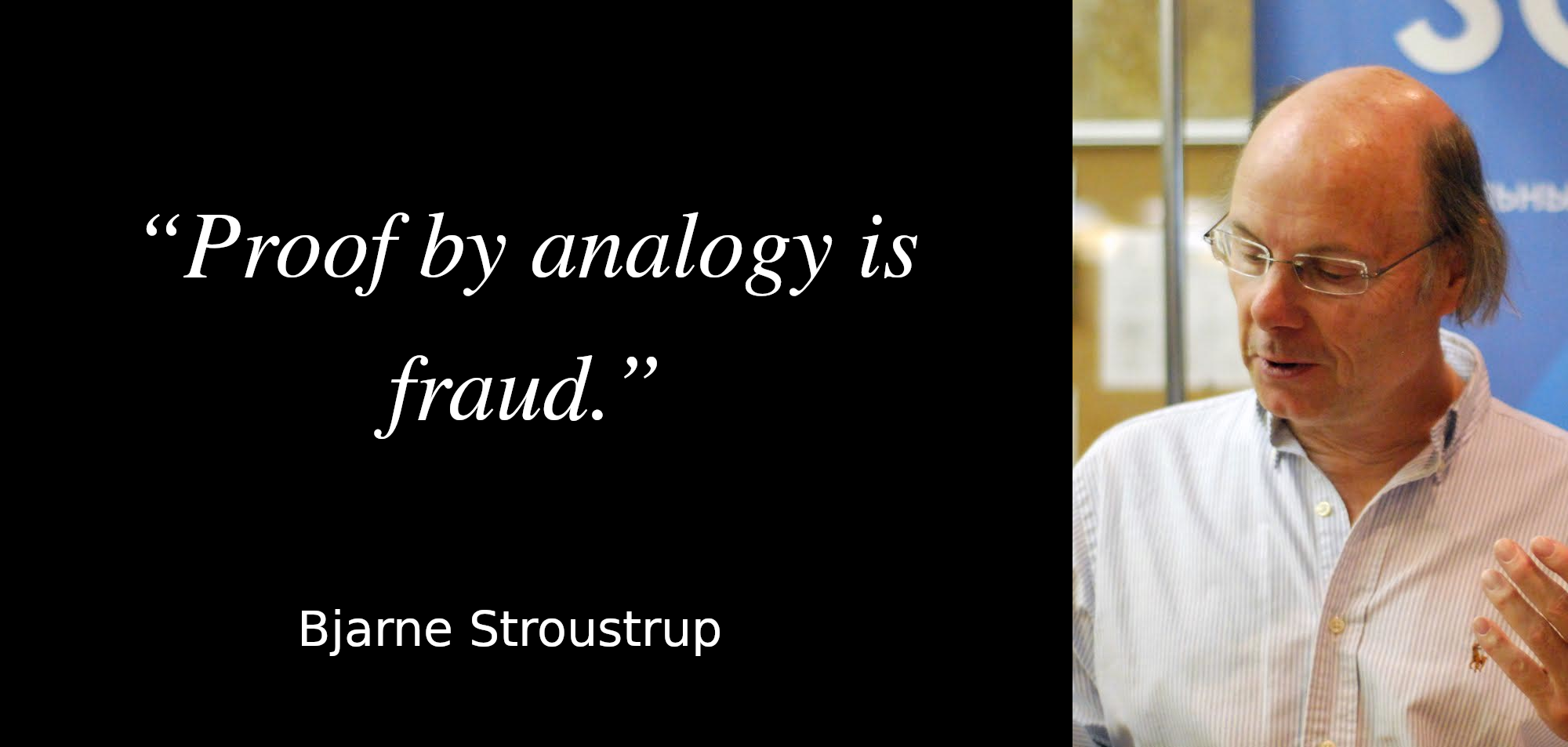
Proof by analogy is fraud. - Bjarne Stroustrup
  • XEX* provides the adversary with an encryption and a decryption oracle.
    • Add b𝔹b \in \mathbb{B} to the tweak
    • If b=0b = 0, use XE for CPA-security otherwise XEX for CCA-security
    • forbidden to query both (0,N,T)(0, N, T) and (1,N,T)(1, N, T)
    • forbidden to query decryptions with b=0b = 0.

XEX*

  • Game 1: XEX* with regular blockcipher: p1:=Pr[𝒜𝖤𝗇𝖼K(,),𝖣𝖾𝖼K(,)(1λ)1|K𝔹λ]p_1 := \Pr\left[\mathcal{A}^{\mathsf{Enc}_K(\cdot,\cdot), \mathsf{Dec}_K(\cdot,\cdot)}(1^\lambda) \Rightarrow 1\middle|K \leftarrow \mathbb{B}^\lambda\right]
  • Game 2: XEX* with random permutation: p2:=Pr[𝒜π̃(,),π̃1(,)(1λ)1|π𝖯𝖾𝗋𝗆(n)]p_2 := \Pr\left[\mathcal{A}^{\widetilde{\pi}(\cdot,\cdot), \widetilde{\pi}^{-1}(\cdot,\cdot)}(1^\lambda) \Rightarrow 1\middle|\pi \leftarrow \mathsf{Perm}(n)\right]
  • Game 3: Random Answers: p3:=Pr[𝒜$(,),$(,)(1λ)1]p_3 := \Pr\left[\mathcal{A}^{\$(\cdot,\cdot), \$(\cdot,\cdot)}(1^\lambda) \Rightarrow 1\right]
  • Game 4: Random permutation per tag: p4:=Pr[𝒜f(,),f1(,)(1λ)1|f𝖯𝖾𝗋𝗆𝖥𝖺𝗆(𝒯,n)]p_4 := \Pr\left[\mathcal{A}^{f(\cdot,\cdot), f^{-1}(\cdot,\cdot)}(1^\lambda) \Rightarrow 1\middle|f \leftarrow \mathsf{PermFam}(\mathcal{T}, n)\right]

Hop 1 is pretty much the same as it was with XE, same for Hop 3. Hop 2 is much more complicated and interested students should just read the original paper.

Security of OCB2

Confidentiality

From the original paper:

During the adversary’s attack it asks a sequence of queries (N1,M1),,(Nq,Mq)(N^1,M^1),\dots,(N^q, M^q) where the NiN^i-values are distinct. Since the NiN^i-values are distinct each πiN\pi_i^N and π̃iN\widetilde{\pi}_i^N that gets used gets used exactly once. We are thus applying a number of independent random permutations each to a single point. The image of a single point under a random permutation is uniform, so the output is perfectly uniform. That is all that is needed to ensure that an adversary has no advantage to distinguish the output from random bits.

Authenticity

More complicated, but similar idea.

Attacking OCB

Akiko Inoue and Kazuhiko Minematsu Enter the Stage

  • Let M:=len(0n)||m2M := \mathrm{len}(0^n) || m_2, with |m2|=n|m_2| = n, A:=ϵA := \epsilon, NN arbitrary
  • Use encryption-oracle with (N,A,M)(N, A, M). Receive C[1]||C[2]||TC[1] || C[2] || T
  • Let N:=NN' := N, A:=A=ϵA' := A = \epsilon, C:=C[1]len(0n)C' := C[1] \oplus \mathrm{len}(0^n) and T:=M[2]C[2]T' := M[2] \oplus C[2].
  • Present (N,A,C,T)(N', A', C', T') to the challenger.

Does this really Work?

C[1]=2LE(2Llen(0n))C[2]=M[2]Pad=M[2]E(22Llen(0n))\begin{align*} C[1] &= 2L \oplus E(2L \oplus \mathrm{len}(0^n))\\ C[2] &= M[2] \oplus \mathrm{Pad}\\ &= M[2] \oplus E(2^2L\oplus\mathrm{len}(0^n)) \end{align*}

C=C[1]len(0n)T=M[2]C[2]\begin{align*} & C' &= C[1] \oplus \mathrm{len}(0^n)\\ & T' &= M[2] \oplus C[2] \end{align*}

M=CPad=CE(2Llen(0n))=C[1]len(0n)E(2Llen(0n))=2LE(2Llen(0n))len(0n)E(2Llen(0n))=2Llen(0n)\begin{align*} M' &= C' \oplus \mathrm{Pad}'\\ &= C' \oplus E(2L \oplus \mathrm{len}(0^n))\\ &= C[1] \oplus \mathrm{len}(0^n) \oplus E(2L \oplus \mathrm{len}(0^n))\\ &= 2L \oplus E(2L \oplus \mathrm{len}(0^n)) \oplus \mathrm{len}(0^n) \oplus E(2L \oplus \mathrm{len}(0^n))\\ &= 2L \oplus \mathrm{len}(0^n) \end{align*}

T*=E(23LΣ)=E(23LM)=E(23L2Llen(0n))=E(22Llen(0n))=Pad=M[2]C[2]=T\begin{align*} T^*&=E(2\cdot3L \oplus \Sigma')\\ &= E(2\cdot3L \oplus M')\\ &= E(2\cdot3L \oplus 2L \oplus \mathrm{len}(0^n))\\ &= E(2^2L \oplus \mathrm{len}(0^n))\\ &= \mathrm{Pad} = M[2] \oplus C[2] = T' \end{align*}

Preliminary Summary

This is a valid forgery containing a never requested plaintext!

OCB2 is not a secure authenticated encryption scheme!

What went wrong?

“But there was a proof that it is secure!”

“Since the NiN^i-values are distinct each πiN\pi_i^N and π̃iN\widetilde{\pi}_i^N that gets used gets used exactly once.”

“forbidden to query both (0,N,T)(0, N, T) and (1,N,T)(1, N, T)

⇒ Argument was to hand-wavey!

A broken hand in plaster.

Longer Messages

  • The first m2m-2 Blocks only xor the checksum with a known value.
  • Let C[m1]=i=1m2M[i]C[m1]len(M[m])C'[m-1] = \sum_{i=1}^{m-2} M[i] \oplus C[m-1] \oplus \mathrm{len}(M[m])
  • Let C[i]:=C[i]C'[i] := C[i] for i<m1i < m-1.
  • Let T=M[m]C[m]T' = M[m] \oplus C[m]

Similar workout as before, just more complicated.

Distinguishing attacks

  • IND-CCA was the result of IND$-CPA + authenticity
  • It turns out that there is a simple attack
Clark Kent vs Superman: Slightly different looks, still the same person.

OCB2 is not IND-CCA secure!

Attacks only ever get better: Universal Forgeries

  • Extract LL
  • Compute random input-output-pairs for the blockcipher
  • Compute specific input-output-pairs for the blockcipher
  • Compute the ciphertext using the regular algorithm.

Perfect universal forgeries with at most three oracle-queries!

And better: Plaintext Recovery

  • Extract L*L^* with encryption oracle from previous attack
  • pick random j,k<mj, k < m.
  • C[j]:=C*[k]2kL*2jL*C'[j] := C^*[k] \oplus 2^kL^* \oplus 2^jL^*
  • C[k]:=C*[j]2kL*2jL*C'[k] := C^*[j] \oplus 2^kL^* \oplus 2^jL^*
  • C[i]:=C*[i]C'[i] := C^*[i] for i{j,k}i \notin \{j, k\}
  • Perform decryption-query with CC'.

Profit.

Full plaintext extraction!

History of the Attacks

  • OCB2 was widely believed to be secure.
  • Akiko Inoue and Kazuhiko Minematsu find a small crack that allowed a first attack.
  • Bertram Poettering discovers universal forgeries
  • Tetsu Iwata discovers plaintext-recovery

Conclusions

  • Even published proofs can be wrong. Always be sceptical!
  • Hand-wavy arguments can easily be wrong in subtle ways!
  • Unnecessary complexity (XE vs XEX) is your enemy!
  • A small cut can turn into a gaping wound very quickly!

Computer Verifiable Proofs

  • Probably the way to go in the future.
  • Still no silver bullet, things can and do go wrong there as well.

References

Images